
A suspended aerial restaurant consists of a platform structure where guests sit on chairs and fasten their seatbelts. They are then lifted to a height of 40 meters by a crane and kept suspended in the air. In this state, lunch, afternoon tea, or dinner is served. The ordered food, which has been previously arranged in electric warmers, is served by waiters as the restaurant gently moves at this height.
One of today’s most alluring and contemporary projects is the development of a suspended aerial restaurant. Not only does it serve as a captivating tourist attraction, but it also proves to be a highly lucrative and purposeful investment opportunity for business investors.
Aria Gostar Pasargad Khavaran Company proudly stands as the pioneering engineering firm in Iran to conceive and execute this groundbreaking project in the scenic village of Shandiz, Mashhad.


Suspended aerial Restaurant, executed in Shandiz village, Mashhad, by Pasargad Company.
Regarding recreational centers, tourist attractions, investors, hotel owners, and restaurant complex owners, as well as construction executives and contractors, the first aerial restaurant was constructed in Belgium. Subsequently, this concept was exported to fifty other countries worldwide, including various European countries, India, the UAE, Saudi Arabia, Turkey, and more, where they are currently operational.
The suspended aerial restaurant has garnered widespread acclaim from tourists worldwide. As reported by the ISNA news agency, the opening of a suspended aerial restaurant in Saudi Arabia drew tourists to Jeddah, resulting in significant revenue for the restaurant owner.
There are two main types of suspended aerial restaurants that have been constructed. One type serves various functions including dining, private meetings, and events such as engagements. This versatile design is often referred to as a multi-purpose or versatile aerial restaurant. The other type is specifically designed for meetings and conferences, offering a focused space for business gatherings amidst aerial views.

Picture on the right, multi-purpose suspended aerial restaurant , Picture on the left, Meeting-focused suspended aerial restaurant
The multi-purpose type is more common and lucrative, but it also presents greater challenges in terms of construction.
After years of research, planning, and meticulous calculations, Aria Gostar Pasargad Khavaran Company embarked on the ambitious project of constructing the world’s largest and most sophisticated suspended aerial restaurant. Consequently, it now holds the position as the second largest manufacturer of such establishments globally.
The designed structure accommodates up to 32 people, stands at a height of 40 meters, and weighs 10 tons.
The suspended aerial restaurant operates solely in a vertical direction, moving up and down without any lateral or rotational motion. The movement is deliberately slow, ensuring that passengers hardly notice it. Guests are seated in their chairs and elevated to a height of 40 meters for a duration of one hour by a robust iron scaffold structure. Subsequently, they descend slowly, a process repeated multiple times throughout the day.
The restaurant, erected in Iran, stands as the most equipped, tallest, and largest suspended aerial restaurant globally.
While its Belgian counterpart is designed for 24 people, the Iranian restaurant accommodates 32 people, resulting in greater revenue generation.
It’s worth mentioning that suspended aerial restaurants worldwide are typically moved using cranes. However, the use of cranes poses significant risks and incurs considerable costs. Pasargad Company has innovatively designed a robust tower-like structure that simplifies installation and facilitates vertical movement of the restaurant, eliminating the need for cranes.


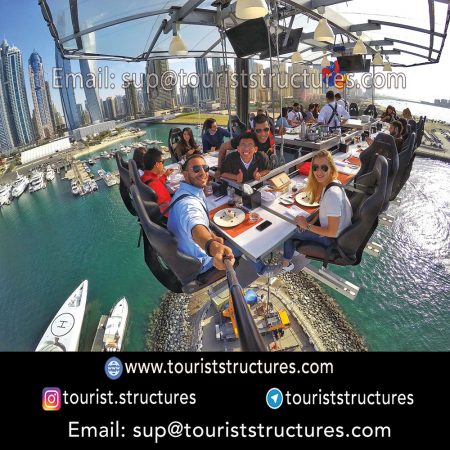
Pictures showcasing various suspended aerial restaurants implemented using a crane across the world
Not only does this approach lower costs and enhance profitability, but it also ensures high strength and reliability. Unlike their Belgian counterparts, the aerial restaurant crafted by Pasargad Company is equipped with 34 heating devices, allowing the establishment to operate seamlessly even during the coldest days of the year.
In the Iranian rendition of the aerial restaurant, a food heater has been ingeniously devised to keep forty dishes warm. This addition allows for the serving of a wide array of foods, including kebabs and various Iranian dishes in the aerial restaurant. Conversely, Belgian counterparts, lacking such heaters, tend to limit their offerings to desserts.
All tools, equipment, and supplies used in constructing the desired structure adhere to industry standards and they are fabricated by seasoned and specialized engineers. When comparing the Iranian aerial restaurant to its Belgian counterpart, it’s evident that the belt type and overall service system of the former are notably richer and more extensive.
All equipment installed on the structure is powered by electricity, enhancing safety measures. Furthermore, it is not equipped with any gas cylinders or flammable materials.
Suspended aerial restaurants are popular in some countries around the world. However, due to the fact that their lifting system relies on cranes, which are only permitted to carry non-living loads, Iranian regulations do not allow for the operation of this type of restaurant.
In 2017, Pasargad Company launched an aerial restaurant in Shandiz, Mashhad, using a crane for a trial run. In the following years, they upgraded the lifting system to achieve much higher quality and safety standards than those of a crane.
Currently, suspended aerial restaurants operate using two systems: a counterweight system and a central shaft system, both in Iran and around the world. Suspended aerial restaurants in Isfahan, Chalidarre, Las Vegas, and Dubai are among the most luxurious and unique dining experiences available both domestically and internationally.
The construction of this type of restaurant, the first of its kind in the Middle East, revolutionized the development of unique and tourist-oriented structures in the country.
Today, we are proud to announce that Arya Gostar Pasargad Khavaran Company, through its extensive knowledge, experience, and continuous efforts, has successfully patented the design and construction of this structure.
The chart below provides a detailed categorization of the various types of suspended aerial restaurants. Selecting any of the options will navigate you to the corresponding idea page.

Selecting any of the green options will navigate you to the corresponding sub-pages of the website.
